

Full S3 API
Your applications, SDKs, and tools work as they are. Point them at a new endpoint — nothing to rewrite, nothing to relearn.
Enterprise S3 object storage on your infrastructure.
Petabox Object Storage is S3-native object storage that runs on your own infrastructure — in your data center, your colocation racks, or your private cloud. It exposes the full S3 API, so the applications, SDKs, and tools you already use keep working without changes. Your hardware, your data, your keys.
It is built for teams that keep petabytes of data and want them under their own control — because public cloud has become too expensive, too opaque, or simply not an option. Petabox scales from a single rack to multiple data centers and expands online as your data grows. Storage you own and pay for like hardware, and use like the cloud.
Your applications, SDKs, and tools work as they are. Point them at a new endpoint — nothing to rewrite, nothing to relearn.

It lives on your hardware, inside your perimeter. Nobody outside can read it, move it, or switch it off.

No egress fees, no per-request charges, no surprise line items. Capacity costs the same next month as it does this one.

From a single rack to several data centers. Add capacity online, expand across data centers, and keep the same namespace throughout.
Residency is a fact, not a policy: the data sits in the facility, the country, and the jurisdiction you chose, and there is no replication path out of it unless you configure one. Access is scoped per bucket and per key, and the people who operate the platform are bound by the same rules — no vendor-side account, no support backdoor, no remote session without your approval. Every request, administrative or not, lands in an audit trail that you keep and can hand to a regulator. Encryption keys are generated and stored on your side; we never hold a copy.
Public cloud storage looks cheap per gigabyte and gets expensive everywhere else: egress, requests, retrievals, and a bill that changes every month. Petabox has none of that. You pay for capacity, and capacity is the one number you can plan years ahead — it doesn't grow because your users read more, a pipeline ran twice, or someone pulled a full export. You keep the part of the cloud that works, the S3 API and elastic growth, and drop the part that was draining the budget.
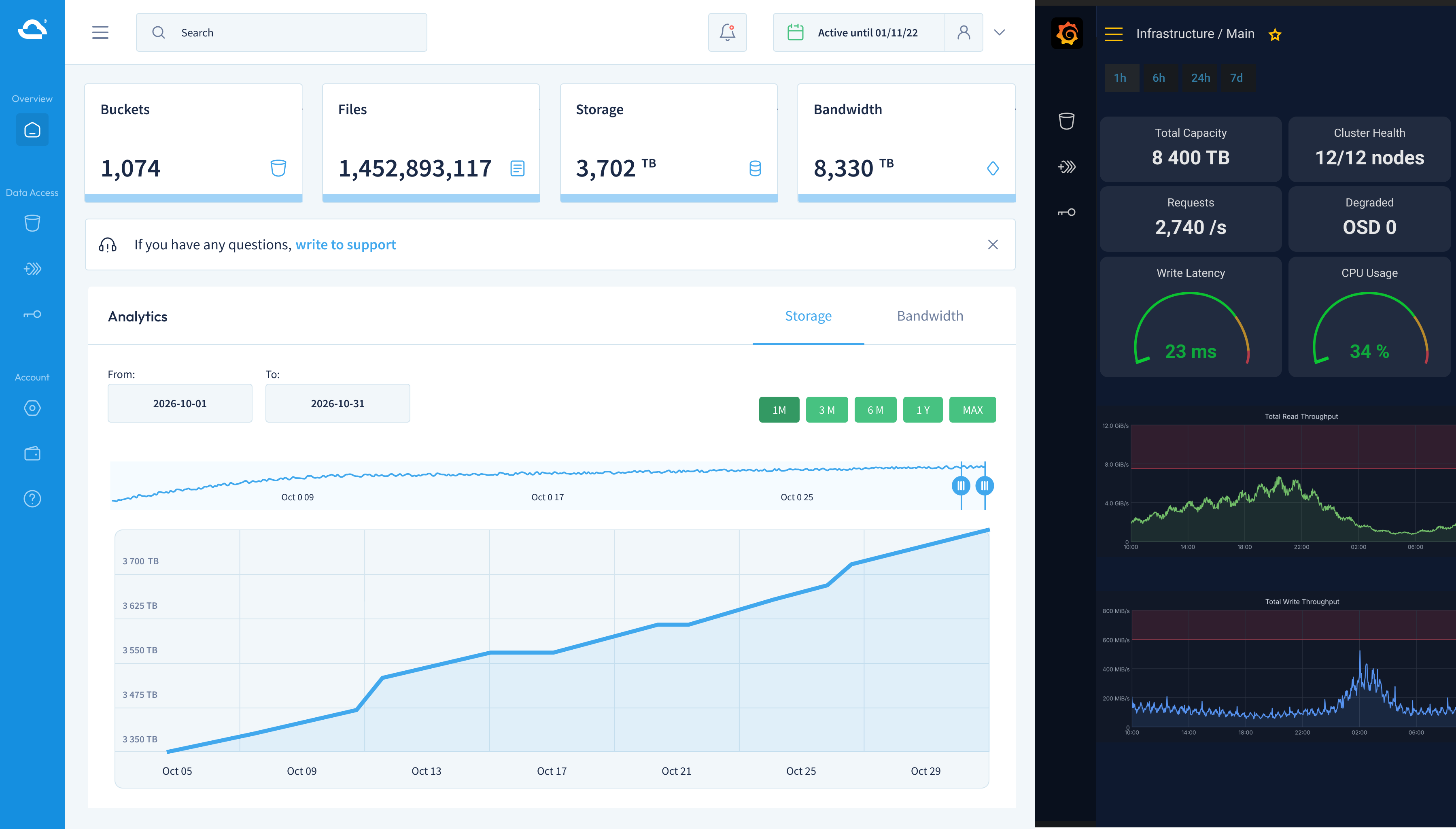
One screen tells you what is stored, how fast it is growing, and how much headroom is left — capacity, traffic, and cluster health, all in real time. The console manages buckets, access keys, and quotas; infrastructure dashboards show node and disk status, latency, and throughput for your engineers. The same data is exposed as Prometheus metrics, so it plugs into the monitoring you already run.
Native S3 gateway. Petabox is a native S3 gateway, not Ceph's RGW. It talks to RADOS directly, or runs on any POSIX-compatible file system — local disks, a distributed FS, or the storage you already have.
Metadata in a database. Metadata lives in a dedicated database, not inside the object store. Listing a bucket, resolving a prefix, or reading an object's attributes is a database query rather than a scan of the underlying storage.
Heterogeneous storage. One namespace can span several file systems and storage tiers at once — fast NVMe for hot data, dense HDD for archive, an existing Ceph pool next to a new one.
Multi-DC namespace. Buckets replicate between data centers and stay addressable under the same endpoint.
Online capacity expansion. Add disks or nodes to an existing cluster and it rebalances while serving requests; add a new cluster or file system and bring it under the same namespace without rebalancing what is already there.
Lifecycle tiering to external S3. Lifecycle rules can tier cold objects out to external S3 storage, encrypted, while they stay visible in the same namespace and reachable through the same API.
Erasure coding and replication. Durability comes from the backend, with erasure coding or replication chosen per pool to fit the data. On Ceph, a failed disk or node is rebuilt automatically while the cluster keeps serving requests.
Asynchronous space reclamation. Deletes return immediately and the space is reclaimed in the background. Bulk cleanups, lifecycle expirations, and retention sweeps don't stall the clients that are still reading and writing.
Any standard x86 hardware. Standard x86 servers from any vendor, with any mix of disks — NVMe, SSD, and HDD in the same cluster, old generations next to new ones. There is no certified hardware list and no proprietary appliance: you buy what is available and what fits the budget, and add it to the cluster as it arrives.
S3 data controls and observability. Versioning, lifecycle rules, Object Lock, and server-side encryption are supported. Metrics are exposed in Prometheus format, and the infrastructure dashboards run in Grafana.

Iceberg, Spark, Trino, and ClickHouse read the same buckets. Scale compute when the query needs it and storage when the data does — without copying datasets between systems or shipping them out of the building.
Solutions · S3 Data Lake

Training wants NVMe, the archive wants HDD, and nobody wants two storage systems. Fast and dense clusters live in one namespace, so the pipeline reads one endpoint and you pay for speed only where it is used.
Solutions · AI / ML Data Layer
Dense HDD with erasure coding keeps the cost per terabyte low; Object Lock and WORM retention keep the data exactly as written — for an auditor in seven years, and against ransomware that got as far as the admin account.
Solutions · Immutable Archive Storage
Thousands of cameras never stop writing. Recent footage stays on fast storage for immediate review, older recordings move to dense HDD automatically, and retention grows from weeks to years without a redesign.
Solutions · Video Surveillance StoragePetabox Object Storage was designed and built by the same engineering team that works with it in production. We wrote the software, designed the architecture, tested the failure modes, and have dealt with overloaded clusters, failed hardware, difficult upgrades, and recovery when real infrastructure behaved differently from the plan.
That experience goes straight back into the product. When a workload exposes a bottleneck, an operational limitation, or a failure mode we did not anticipate, we can work below the configuration layer and change the platform itself.
Infrastructure does not stand still. Disks get denser, new server generations arrive, a second data center comes online, a regulator changes what may be stored where. Petabox is not tied to the hardware it was first installed on: a new storage tier, a new file system, or a new cluster is added alongside the existing ones, and the data in place stays where it is. You replace equipment on your schedule, not on a vendor's.
The platform evolves in place as well. New capabilities and architectural changes are introduced without rebuilding the storage environment from scratch, and upgrades are applied in place, without migrating data between versions. New generations of the product arrive the same way new hardware does — added to the installation you already run, while applications keep using the same S3 layer.